

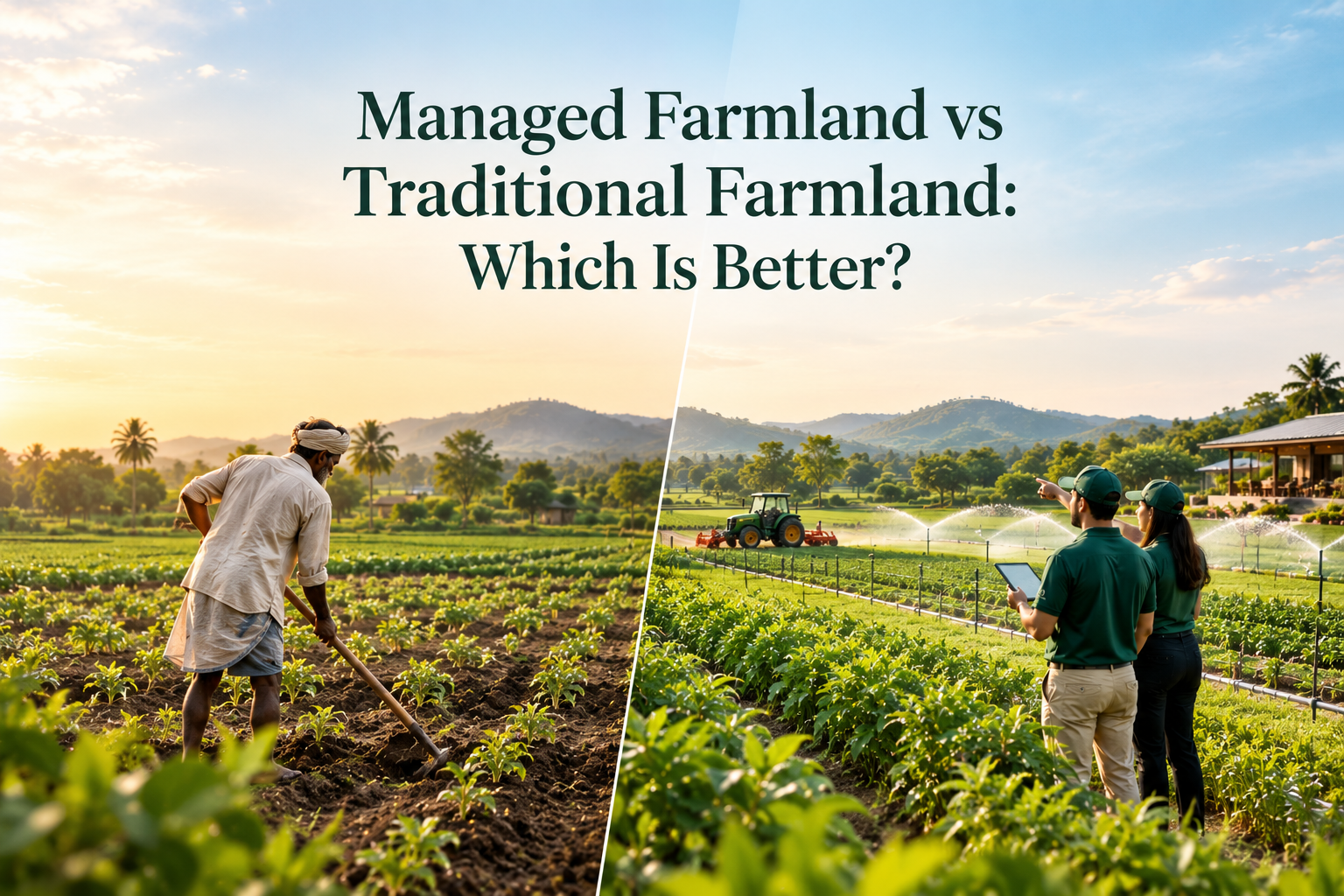
Having farmland provides one with access to nature, space, and the chance to learn more about agricultural land ownership apart from city life. But whether or not being a landowner will be satisfying depends on how the land is kept.
Traditional farmland allows the owner to become directly involved in agriculture, whereas managed farmland ensures professional assistance for the fulfilment of agricultural and maintenance duties that have been discussed. Knowing the difference will help the buyer make a choice according to his/her lifestyle, free time, and intentions.
Choosing between two kinds of farmland is not just the choice itself for new buyers; it is more than that. One has to be aware of the responsibilities, costs, flexibility, and degree of participation related to each alternative.
What Is Traditional Farmland?
Traditional farmland is agricultural land where the landowner takes charge of all decisions regarding cultivation, farming, irrigation, labor, and other such matters concerning the farm.
This is an area where there are many possibilities. Owners will decide on agricultural matters within the context of laws governing the land and will also decide on the structure of day-to-day management.
Management of farm land involves spending time, planning, and knowing the local agricultural situation.
This may require organizing workers, monitoring the crops, arranging water supply, and dealing with other such problems arising out of different seasons. Owners living away from their farms may find supervision a problem.
It is ideal for those who wish to manage the lands they buy and have the necessary experience or interest in agriculture.
What Are Managed Farmlands?
Managed farmland is a mixture of owning the farmland as well as the professional help of some individuals in conducting certain agricultural practices and/or upkeep.
Depending on the agreement made and the type of project in question, there might be coordinated planting, irrigation, upkeep, employment of agricultural laborers, and so forth.
The idea behind this practice is to facilitate some aspects of farmland ownership, especially for individuals who may not be able to visit the farmland often.
For instance, an individual who lives in Bangalore may be interested in owning farmland close to his/her residence but is unable to visit the farmland often enough to ensure certain operations are conducted. Managed farming would enable him/her to allocate these responsibilities to professionals.
It is necessary to note that all projects are different in terms of the scope of service provided. While in some cases the service is about mere upkeep, there are projects which will include agricultural activities as well as communal facilities.
One more important thing to keep in mind is that the involvement of professionals does not mean there are no risks involved in agriculture or any particular outcome expected financially.
Managed Farmland vs Traditional Farmland: Key Differences
However, despite the similarity in land acquisition, the daily operations in both cases can vary greatly.
Factor | Traditionally Farmed Land | Managed Farmland |
| Daily operations | Coordinated by the owner and/or employees | Coordinated according to agreed-upon responsibilities by the management team |
| Active participation of the owner | More frequent | Can be less frequent |
| Agricultural decisions | Usually made by the owner within the framework of relevant regulations | Dependent upon the specifics of the management agreement |
| Maintenance | The owner organises and controls actions | Actions organized by the management team according to included services |
| Time demands | Can require frequent attention | May provide more conveniences |
| Expenses | Workforce, inputs, equipment, and maintenance | Management fee and agricultural/farming expenses |
There is no automatic superiority of either one over the other. The choice must take into consideration the specifics of the property, the expectations of the owner, the level of management, and the costs of ownership.
What Are the Benefits of Farmland Ownership?
Prior to making a decision between the managed land and conventional land, one should be aware of the general advantages of farmland.
These advantages go beyond the management type and are determined by such factors as geographical position of the property, its legal status, agricultural potential and intended usage.
A Link with Nature
Farmland is an entirely different type of environment compared to crowded cities. Green landscapes and seasonality allow getting some relaxation and spending leisure time in nature.
It can serve as a place where one can relax and have time with nature from time to time.
A Venue for Agricultural Activity
The farmland can give a chance to try themselves in such activities as cultivation, plantation, etc. The potential of such activities is dependent upon soil, water, climatic conditions and local legislation.
One should consider the potential of the land in terms of agriculture; not all lands allow cultivation of each plant or plantation.
A Long-Term Ownership Perspective
Other buyers might think of farmland as part of their strategy for land ownership over an extended period of time. However, the future value of such land depends on various factors like location, accessibility, land use regulations, infrastructure, market conditions, and other ongoing costs.
Farmland must not be bought under the impression that its value will always rise or that it will generate profits.
Family Time and Individual Well-Being
The other aspect of farmland ownership is the opportunity for owners to get away from all the hustle and bustle of everyday life and spend time in the open air with their family. Farmland can offer such opportunities if they are compatible with the purpose for which the land is used.This kind of aspect is important for potential buyers too.
Advantages of Traditional Farmland
Conventionally managed farmland may prove an attractive option for individuals who would prefer active participation in the process of farm management.
The benefits of this option include flexibility, personal management, and customization of usage of the land in accordance with regulations.
More Control in Managing the Farming Process
The owners of privately managed farmland will have control in organizing the planting of crops and organizing labor. It may be particularly helpful for those individuals who possess some knowledge about agriculture.
Control means that the owners of farmland will have to make informed decisions and solve any potential issues on their own.
Managing Costs Flexibly
The owner of traditional farms has freedom to organize labor force, supply goods and perform maintenance works. He can evaluate various companies and decide on how to manage different responsibilities himself.
Nevertheless, cost-effectiveness is not always possible. Miscommunication, lack of equipment, need for repairs or unproductive farming will increase costs.
Practical Skills and Experiences
If a person is willing to be engaged in agricultural activities, he or she can use traditional farmland to be involved in actual process of cultivating crops.
It will bring pleasure but also takes time, effort and readiness for changes.
Benefits of Managed Farmlands
Farmed lands could attract buyers in case they prefer professional coordination to being responsible for each operation themselves. It depends on the level of experience of the management service provider and the range of services offered.
Professional Coordination
To maintain farmland, there is always need for timely actions like irrigating, planting, soil status checking and maintenance. It will be managed according to the schedule agreed between both parties.
For buyers without such experience it could ease their understanding of the issue. Still, buyers need to pay attention to the experience of the management team, their way of communication and problem-solving.
Greater Convenience for Urban-Based Owners
Some people with other occupation and obligations could not be available to check on their farmland. Managed lands could help in coordinating the agreed actions when the owner is away.
It could be especially important for buyers considering farmland near Bangalore city or other cities. But one should consider other aspects as well.
More Organised Maintenance
The establishment of an effective management strategy will enable the determination of the people who are responsible for the maintenance, scheduling of activities, and notification of the owner.
This will lead to less confusion as long as there is a proper understanding of the services provided, fees charged, and accountability involved.
Support for Future Maintenance
Regular maintenance will enable the continued organisation of agricultural activities. This, however, is influenced by various factors, which include soil conditions, resources, weather, water sources, and the quality of work.
Unexpected costs or any other change in future plans of farming must also be known to the owners.
Which Option Is More Cost-Effective?
Cost is one of the key issues in making comparisons between managed and conventional farmland. But cost alone does not show the complete financial outlay involved in either case.
Cost of labour, irrigation, equipment, agricultural inputs, transport, repairs, and supervision may be incurred in the case of conventional farmland. The owner might also have to consider the cost of his own time or of hiring people to supervise the activities.
In the case of managed farmland, there may be recurring costs of management besides other costs. Buyers should make sure that the quoted cost covers general maintenance, agricultural labour, irrigation, plantation management, shared facilities, or selected few services.
The best way to make the comparison is to see how much the total cost will be over several years.
But another critical issue is to separate the lifestyle factor from that of the finances. Neither of the two can guarantee agricultural profits or increase in capital.
How to Choose the Right Farm Plots for Your Needs
The choice of appropriate farmlands cannot be made by evaluating only the type of management. The land, its legality, and responsibilities connected with it must be considered when making a decision.
First of all, verify the ownership title, plot boundaries, land classification, any encumbrances on it, and its legal restrictions. Seek advice from an independent property lawyer who knows about all laws related to land use in that state, especially if the land is managed as a part of some project.
Secondly, analyze the land’s agricultural properties. Its soil composition, water availability, drainage conditions, road access, and possibility of plantation activity might affect the use of property and management of it.
Thirdly, review the agreement on professional management if professional management is provided. Ask for a list of services provided by it, fees paid repeatedly, other costs, decisions taken by you, and the dispute settlement mechanism.
Finally, define the main goal of purchasing farmland. Buyers who wish to cultivate lands themselves will like traditional farmland better, while buyers who have limited time and need professional management will choose managed farms. For those who are looking for a nature-based way of life, environmental aspects must be analyzed.
Exploring the Quiet Earth by SBC Earthfulness
As a buyer researching managed farmlands around Bangalore, The Quiet Earth by SBC Earthfulness will be suitable for you since it is a natural approach to the ownership of land around Denkanikottai close to Hosur, in Tamil Nadu.
This project is designed around the concept of having a reflective approach to land, green areas, and the rural setting. It may suit those buyers interested in exploring the natural way of living while taking into consideration the practical aspects of owning farmland.
When assessing a project like The Quiet Earth, a potential buyer should assess various factors, including the ownership type of the particular plot of land, the management service, the cost involved, and the facilities offered.
It is important to check on the status of the project, the documentation required, and the possible use of land. An actual visit to the site may be helpful in understanding the surroundings and the planning involved in the whole process.
Conclusion
The choice of managed or traditional farmland lies in the extent of involvement, flexibility, and support expected from the ownership of land. Traditional farmland may prove to be suitable for those people who desire direct involvement and practical experience in agriculture.
Managed lands would be beneficial for individuals who require professional assistance with specific farming and maintenance operations. Both the types provide opportunities in terms of lifestyle and agriculture, but none of them take away the need for proper planning.
Before selecting your farmland, take into account the amount of time, money, usage, and management involved in agricultural activities. This information would assist you in making an informed choice of your desired ownership type rather than opting for something just because of the trends.
Frequently Asked Questions
1.What is the principal difference between managed farmlands and traditional farmlands?
Traditional farmland is usually under the direct management of the owner or by employees hired independently. Managed farmland involves professional assistance for farm management and maintenance of the obligations negotiated as per the management contract.
2.Are managed farmlands appropriate for new buyers?
They can be appropriate for first-time buyers without any agricultural experience or free time to supervise their land. However, new buyers should be familiar with the legal documentation and know the management costs and the remaining obligations.
3.Is traditional farmland less expensive than managed farmland?
It is not always the case. Traditional farmland can cost more because of labour costs, maintenance costs, and supervision costs, whereas managed farmland can incur management costs.
4.Is agricultural income and/or appreciation assured in managed farmland?
No. There is no assurance of either. This will be dependent on several variables, such as location, soil, and water quality; the market; the cost of operation; and the general economy.
5.What should I consider when purchasing farmland?
Make sure to investigate the title of ownership, the class of the land, survey information, water, access, allowed land use, and costs involved. For managed farmland, the service contract should also be reviewed.


