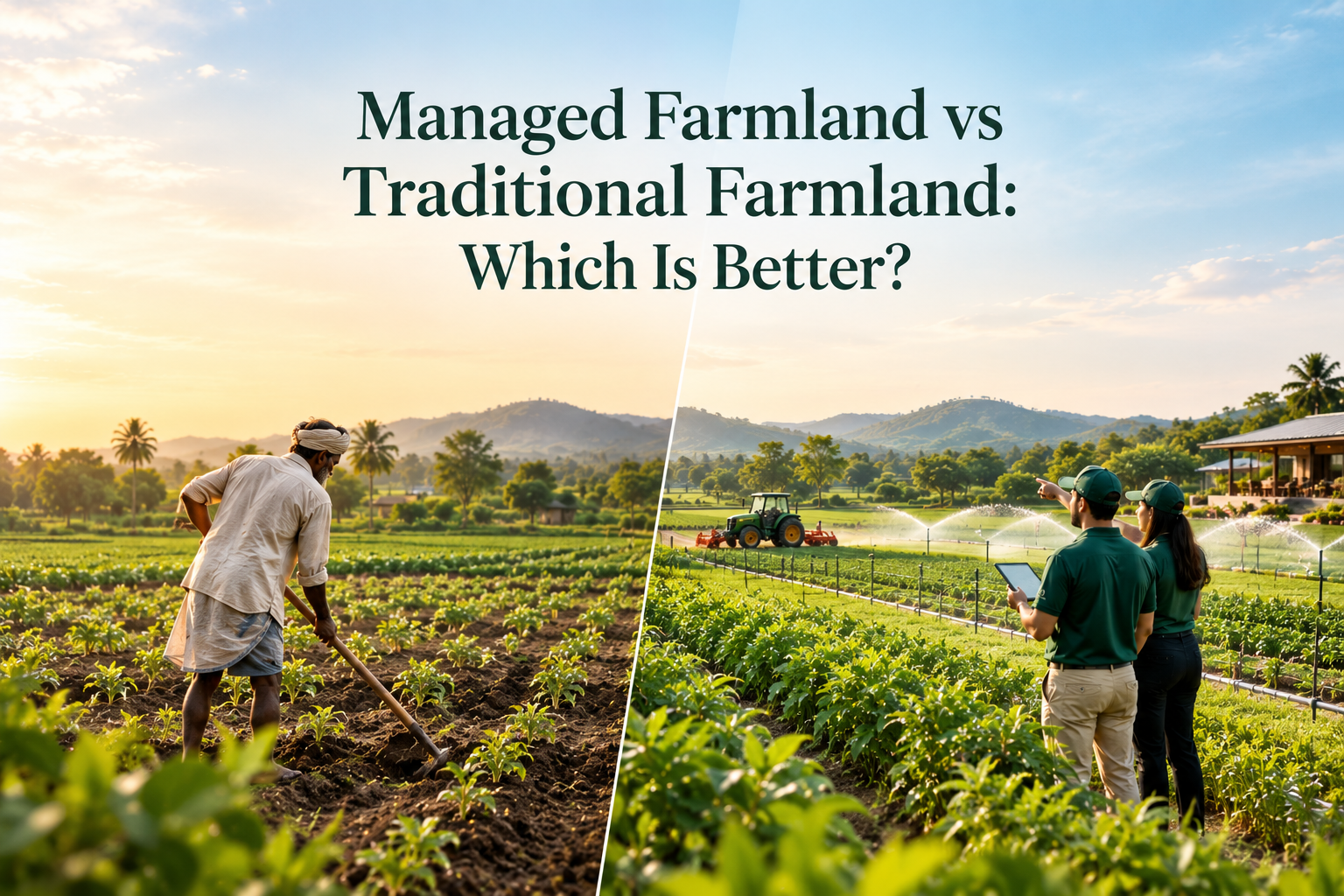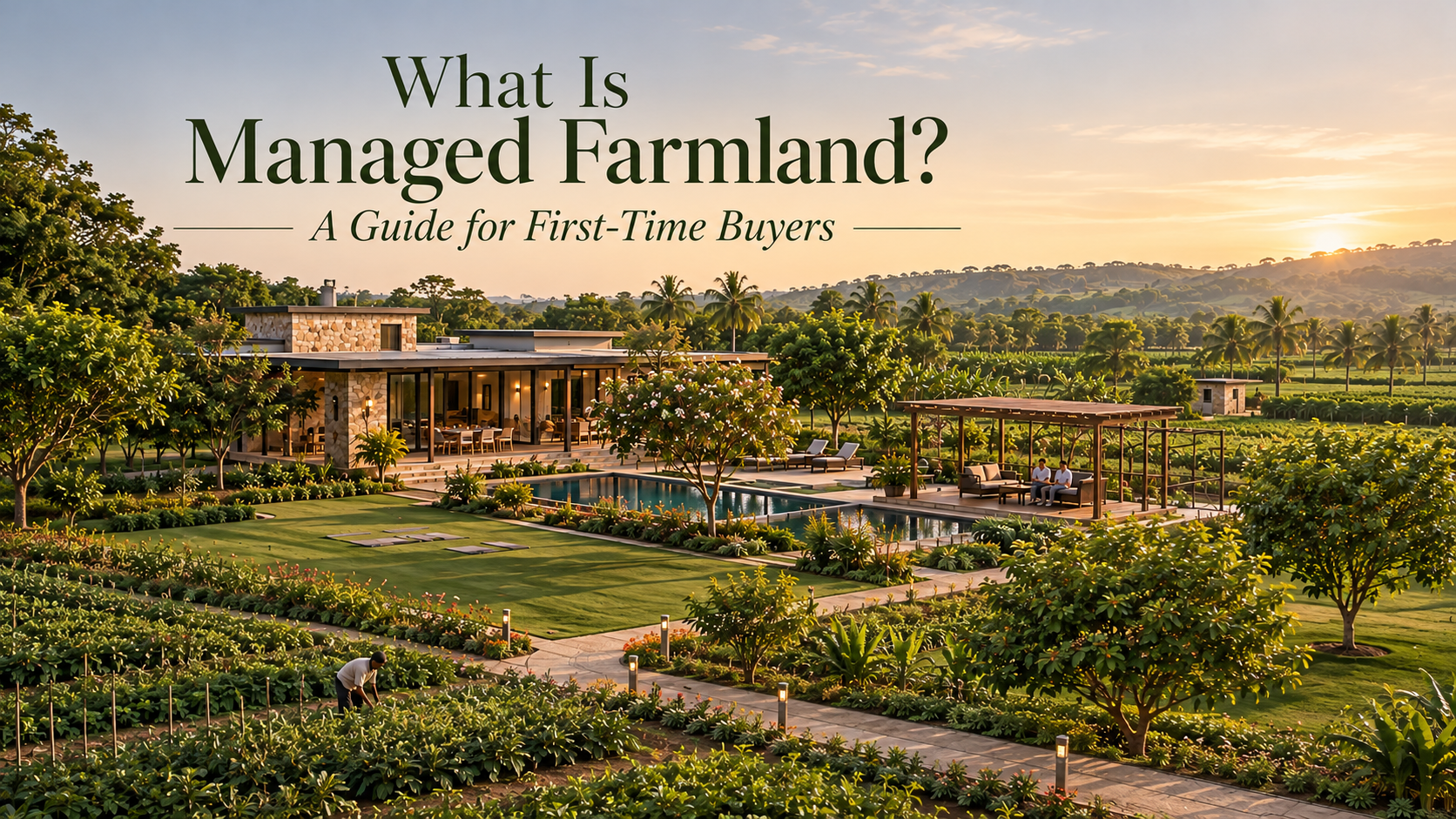
To those who seek roomier spaces, better interaction with nature, and a careful attitude toward owning land, getting to know what is managed farmland is beneficial. Managed farmland differs from ordinary farmland in that, along with owning the land, there is additional professional assistance for running the farm and keeping it in order.
Thus, for new farmland owners, this option may become more understandable and manageable. Managed farmland near Bangalore may serve as an example of this concept.
Nevertheless, buying farmland requires more than finding a nice place. It requires understanding the ownership and management process, all the documents needed, etc.
What Is Managed Farmland?
Managed farmland means agricultural land where some agricultural tasks are done by a specialized management team on behalf of the landowner.
The tasks can be plantation planning, irrigation coordination, soil protection, maintenance, and monitoring of farming activities, depending on the nature of the project.
In the case of farmland purchase, the owner carries out all these tasks personally. This process involves agricultural skills, hiring of local labourers, supervision, and taking care of difficulties.
Hence, buying managed farmland gives another option to those people willing to buy agricultural land but unable to manage everything themselves.
Services will be different depending on the project. There are management teams only managing their lands, and there are those that manage their land and help with cultivation. So, in any case, buyers have to know what kind of services the developer offers.
The main difference is that ownership and management of the land are separate. Purchasing of managed farmland does not mean that everything will be done by the developer.
How Does Managed Farmland Work?
This normally starts with finding an appropriate plot, studying its legal papers, familiarizing oneself with the management system, and completing all the necessary formalities in purchasing and registering the land.
After the purchase is complete, the management takes care of performing the assigned responsibilities. The owner is allowed to take part in decision-making, as per the agreed contract, while all other tasks may be carried out by professionals responsible for managing the land.
Below is the mechanism of operation in such cases.
Selecting and Purchasing a Farmland Plot
The buyer finds a plot depending on its location, size, accessibility, land qualities, and planned use. Prior to the purchase, it is recommended that the buyer conducts independent research regarding the land’s title deeds, boundaries, land classification, any restrictions, and registration procedure.
It is important to know the legal structure of the transaction since, in some projects of farmland under management, both individually owned land and communal infrastructure or roads might be used.
Planning Farming Activities
It all depends on the project; in some cases, the management team can assist to identify the right planting or cultivating activity according to the available soil, water, climate, and objectives of the agriculture.
The buyers must find out whether the choice of crops is covered in the offered service, who makes the decision regarding farming activities and how any change in weather and crop conditions will be managed.
Coordination of Maintenance
Maintenance may include irrigation, plantation, weed removal, soil, and coordination with the agricultural staff. This all depends on the list of services offered by the management company.
Clearly identified arrangements allow knowing what will be done, how often the activities will be conducted, and whether there are additional fees for this work.
Keeping In Touch with the Land
Sometimes, the projects provide information about the maintenance, development of the plantation or other activity on the farm. It all depends on the format of communication and how often it takes place.
It may be helpful for those people living in the city and not being able to see their land very often.
Managed Farm Plots vs Traditional Farmland
Both choices provide land ownership, but the degree of participation varies greatly.
Factor | Traditional Farmland | Managed Farm Plots |
| Day-to-day coordination | Is carried out by the owner | Can be carried out by a management team |
| Agriculture planning | Takes place on an individual basis or with professionals hired | Can include professional consultations |
| Maintenance | The owner coordinates work and activities | Depends on the type of management services agreed upon |
| Owner participation | Can be active | Can vary depending on the agreement |
| Costs | Farming and maintenance costs | Management costs and other costs |
| Decision-making | Is made directly by the owner, in compliance with the relevant regulations | Responsibilities are divided between parties according to the agreement |
One choice does not necessarily have to be better than another one for all potential owners. Farmland might be more suitable for an experienced agricultural worker, while managed farm plots can suit those who like to delegate responsibilities.
The choice depends on how much time and effort a potential buyer can put into the process.
What Are the Benefits of Managed Farmland for First-Time Buyers?
Effective management of farmland can make it easier to be an owner, particularly for individuals who have no prior experience in farming practices. Still, its advantages depend on many factors, such as the level of management, property conditions, and terms of the agreement.
Assistance in Agricultural Activities
Farm management implies the organization of irrigation procedures, the state of the soil, the plantation, the season’s requirements, etc. In turn, a professional group can arrange all these issues according to a certain plan.
For new owners, it can be helpful because of the opportunity to not organize each action individually. This assistance cannot eliminate all the risks associated with farming; however, it makes them less confusing.
The Comfortable Possession of Land
It is common that new owners live in urban areas and work there; thus, they have a lack of time for constant farm visits. With the help of farmland management, one may feel close to his property without having to organize all actions of maintenance himself.
This advantage is very important when speaking about managed farmland in the area of Bangalore.
However, prior to purchase, it is essential to investigate the actual travel time, road condition, and accessibility of the project.
Closer Contact With Nature
It is possible that farm land may represent an alternative to urban living. The open space, the plantation, the changing seasons, and spending time outdoors can be appealing to those who look for a place of quieter life.
In many cases, the reason why people choose to have a piece of farmland is not farming alone but also having a family retreat and having closer contact with nature.
Such experience can be influenced by the location of the land, its surrounding areas, facilities available there and the activities allowed.
Structured Maintenance Approach
Having an organized approach to maintenance activities can assist in making sure that such activities do not get forgotten due to the owner’s absence.
Nevertheless, one still needs to find out about the experience of the maintenance team, the quality of their services, the degree of their responsibility, and the complaints policy.
Potential for Long-Term Land Ownership
For some individuals, farmland is considered part of the asset and lifestyle strategy. The financial aspect of investing in agricultural land relies on certain aspects, such as the geographical location of land, legal issues, conditions of the land, demand, development issues, and the expenses related to the possession.
A managed approach does not mean that there will be any capital gains, agricultural profit, or specific returns on investments.
Is Managed Farmland Investment Suitable for You?
A managed farmland investment might be suitable for those who would like to own land, admire the beauty of nature, and get assistance with agricultural land management. Additionally, this approach might suit those who would like to experiment with farmland without handling the management completely.
First of all, think about why you want to buy this type of land.
If you want to actively engage in cultivation, think about how much power you will have over decision-making. If you want to use the land to spend your weekends on, consider accessibility, surroundings, and activities on the land.
If your main aim is the financial gain, check out the expenses, risk, and holding period realistically without counting on the projected profit.
In addition, it is important to understand the difference between the agricultural land and residential land. You cannot build a farmhouse, open up a business of hospitality, or do other things just because it is a project offering the managed farmland.
Your purchase has to match both your goals and the permissible purpose of the land.
What Does One Have to Pay Attention to When Purchasing Managed Farmland for the First Time?
The smart purchase begins with the verification of all the necessary information. In order to buy a project, one should consider the following points.
Legal Aspects
Ask about the title papers, encumbrances, survey, land classification, and any other documentation. Find out who is the legal owner of the land, what are the borders of the plot and how the procedure of registration goes on.
Management Agreement and Fees
Find out what exactly the management will be doing. Find out if plantation management, irrigation, labor management, security, maintenance of common areas, or any other service is included. Examine the periodic fees, extra fees, the length of the agreement, termination, and liabilities for extra expenses.
Soil, Water, and Land Conditions
Inspect the land to find out the topography, drainage system, soil conditions, and availability of water. Inquire about the intended agricultural operations and whether they are appropriate for these conditions. If required, obtain an independent technical assessment.
Location and Accessibility
Think about the route, time taken, road accessibility, facilities near the area, and how frequently you will be visiting. An area that is suitable for family visits might not be appropriate for someone who intends to actively participate in farming.
Transparency and Long-Term Planning
Request for information on the present position of the project, plans for further development, availability of facilities, and necessary approvals for proposed activities. Visit the location, if possible, and receive written answers to important questions prior to making the payment.
In this way, first-time buyers will have the opportunity to assess the features of the property objectively, without being dependent only on marketing materials.
Explore The Quiet Earth by SBC Earthfulness
For buyers looking for managed farmland around Bangalore, The Quiet Earth by SBC Earthfulness provides an experience in rural land ownership in Denkanikottai, close to Hosur, Tamil Nadu.
The concept of the project implies the creation of a place that unites the land, its openness, and a responsible attitude towards rural life. This is a project for those people who are interested in living closer to nature, but at the same time are ready to take into account the practical side of the farmland ownership.
For a first-time buyer, it is essential to learn how the system of the project can meet his/her requirements.
Potential buyers must obtain the most up-to-date information about the project, examine the relevant legal documents, and check the exact services, facilities, prices, and allowed uses of the particular piece of land.
The viewing of the property may also give buyers the chance to evaluate the landscape, accessibility, planning, and the general atmosphere of the land in order to determine if the project meets their expectations.
Conclusion
Knowledge of what is managed farmland provides new landowners with some guidance while choosing the right land to purchase. This type of arrangement involves agricultural land ownership as well as professional help in conducting the agreed upon activities, which might make it simpler for individuals without much time or agricultural experience to manage their land.
Nevertheless, the success of the arrangement does not only depend on the phrase “managed”. Legalities, transparent prices, realistic expectations, suitable land, and the proper management agreement are all necessary for a positive experience.
If you are interested in purchasing managed farm plots to live in harmony with nature or are thinking of making an investment in managed farmland, consider the information provided here.
Buyers are thus able to make a well-informed choice regarding whether managed farmland is a good fit for their way of life, priorities, and plans.
Frequently Asked Questions
What is managed farmland?
This is basically agricultural land where a group of experts takes charge of certain aspects of the farming and maintenance of the land. This varies from one project to another.
Is managed farm land right for first-time buyers?
Managed farm plots may be ideal for first-time buyers interested in owning land but lacking the time to coordinate agricultural activities alone. It is important, however, to have the relevant documents verified beforehand.
What is the difference between managed farmland and ordinary farmland?
In ordinary farmland, the buyer is usually responsible for coordinating all the agricultural and maintenance practices, while managed farmland allows you to hire experts to do that on your behalf.
Will there be profits in investing in managed farmland?
No. There are no guarantees for land value increases and income from agriculture. It all depends on various parameters like location, land quality, demand, costs, and risk. Investors need to make their own evaluation and not take assurances at face value.
What do I need to verify before purchasing managed farmland around Bangalore?
Verify the title of the land, land type, land boundaries, water supply, accessibility, management costs, terms of service, and usage of the land. You should always seek advice from an independent land lawyer before signing the deal.